
A major player in Indian political history, the first female Prime Minister of India, and for a time the most powerful woman in the world, Indira Gandhi was an esteemed guest of the Empire Club of Canada. In 1973, while she was still in office as Prime Minister of India, she gave a speech about the history and future of India, from its struggle for independence to its path to democracy and progress towards becoming a modern nation. She also touched on India’s relationship with Canada as a trade partner and Canada’s contributions in terms of credits and grants.
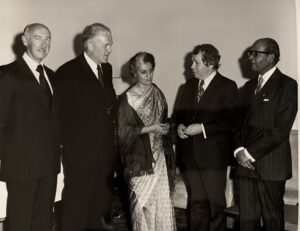
Indira Ghandi at the Empire Club, 1973. ECF photo
Like many post-colonial nations at the time, India was still finding its place in the world, and discovering what kind of country it would be in the late 20th and early 21st century. Gandhi spoke about this process, saying it would be a challenge, but that India would rise to the occasion. “Nearly half of India’s people have been born free and have no personal memory of the colonial days. We are engaged in building the nation, in giving political freedom its full economic and social content.” The South Asian region was still experiencing much conflict at the time Gandhi was prime minister. In 1971, a growing independence movement in East Pakistan, which Gandhi’s India supported, led to a war resulting in the independence of Bangladesh as a nation. She also repelled attacks from China in the Himalayan region in the 1967 Sino-Indian war. Her leadership in both leading the country through these conflicts, and fostering a united Indian identity shines through in this speech, and it is a valuable resource in gaining insight in this period of history.
Gandhi talked about the Indian independence movement, and how it shaped India’s national identity and current situation. “The unity of India is not a legacy of the British,” she said. “Through the centuries India has been a cultural entity which neither conquest nor the changing boundaries of its kingdoms were able to erode. Its political unity in modern terms was a product of the fight against foreign rule and of challenges faced together.” She spoke about the struggle or democracy in the current day, and how it can be used to foster social and economic development without the need for violence and disruption. “The belief that no country has a moral right to rule over another has its corollary that no group within a country can arrogate to itself the right to make decisions for others,” she continued.
Gandhi also spoke about their trade relationship with Canada and the credits and grants that India has been given so far. “We are grateful for the credits and grants and particularly appreciate the fact that Canadian credits have been among the most liberal and most unencumbered that we have received, but as our economic base gains strength, our endeavour will be to earn our external resources through trade rather than aid,” she said. She also mentioned how Canada-India trade relations could be even better, with the goal of reducing the handicaps suffered by developing countries. She closed her speech saying “I think we can be, Canada and India, as someone has said, good companions in this great task of making a better world.”
Although Gandhi was an extremely influential figure in 20th-century politics, she is looked back upon as a relatively divisive figure. From 1975 to 1977 due to internal and external threats, she instituted a state of emergency and suspended civil liberties, jailing over 100,000 journalists and political opponents. In 1984, in response to the Sikh separatist movement, she ordered Operation Blue Star, a military operation, to remove Sikh militants from the Golden Temple, a holy site in Sikhism. Hundreds of Sikhs were killed in this operation, including many civilians. Although she is looked upon positively by many for growing the economy and her anti-poverty campaign, her response to some internal strife led her to be one of history’s more controversial figures.
Gandhi’s speech to the Empire Club Foundation came at a crucial point in her political career. She was still in the process of instituting Indian democracy and implementing social reforms but had not yet faced some of her biggest challenges. Her speech to the Empire Club of Canada provides key insight into her belief in democracy and social justice before certain political developments in her country may have challenged her resolve in these issues. Regardless, anyone interested in this period of Indian history, as well as Canada-Indian relations would have a lot to learn by reading this speech in full.
Other female political leaders who have spoken at the Empire Club:
The Right Honourable Kim Campbell, Prime Minister of Canada, October 22, 1993
The Hon. Kathleen Wynne, Premier of Ontario, spoke three times: April 28, 2014; October 5, 2015: February 26, 2018
Margaret Thatcher addressed the Empire Club as Leader of the Opposition in the United Kingdom on September 25, 1975, as Prime Minister on September 27, 1983 and after her tenure in politics.
Jeanne Sauvé, Canada’s first female Governor General spoke on November 12, 1985.
Written by Silas LeBlanc. Silas is a Toronto-based journalist, writer and content creator. She has previously worked at Xtra Magazine, The Varsity, The Review of Journalism and CJRU 1280 AM.