
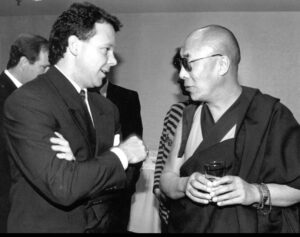
ECC Luncheon, His Holiness The Dalai Lama, Luncheon at the Empire Club of Canada with Gareth S. Seltzer. ECF photo
In September of 1990, the 14th Dalai Lama spoke to the Empire Club of Canada about Buddhism, the history of Tibet, and his philosophies about human nature. The Dalai Lama — the highest spiritual leader in Tibetan Buddhism — has been exiled in India since 1959 due to the Chinese annexation of Tibet. He is seen as a spiritual leader to this day and is an important symbol of the Free Tibet movement, which gained a great deal of traction in the 1990s. He has set up a provisional government in India but makes speeches all across the world about his life experiences and personal philosophies.
In his speech to the Empire Club of Canada, he spoke about how Tibet is uniquely situated among ancient neighbours such as China, India and Afghanistan. He spoke about the inextricable link between Tibet and Buddhism, given that Tibet is the birthplace of the ancient religion, which became extremely influential in many parts of the world. He also spoke about the challenges of living in a modernized world as a culture that wished to stay isolated.
“So as a result, when this century started, Tibet materially remained very backward,” he says. “We see ourselves not prepared for this modern situation. As a result, now we’ve lost our own country. But at the same time, because of the deep spiritual heritage, generally speaking, Tibetans, I think, are quite nice people. They seem quite peaceful – a peaceful nature.”
Due to their ongoing occupation by the Chinese, the people of Tibet have had to stay strong-willed and committed to their cause and religion, which the Dalai Lama acknowledges. He contrasted this to a place like Canada, where the citizens live in relative comfort, and don’t have to face the regular hardships and challenges that the Tibetan people do. He does mention however that no matter where one is born, human beings are human beings and have the capacity for love and compassion. “That I always consider is human affection, human love, human compassion,” he said. “If these two things are there — good heart, warm heart, human intelligence, human wisdom and the material facilities — that I think is the proper way to achieve real meaningful life and, I think, peace of mind.” He says that if one has compassion and love in their hearts, then their attitude towards other people and to the planet will be nicer. The Dalai Lama with the help of science and technology, the human ability has become immense, which could prove disastrous if used negatively. This is why he says there needs to be some sort of universal responsibility based on compassion and love.
The Dalai Lama however is a lot more hopeful about the prospect of peace in the world. He saw the current moment as an era of mutual respect between nations, as opposed to the fear created by the Second World War. “I would like to appeal to our brothers and sisters to think more seriously now whether this present system, the political economy system, whether it is really sufficient, or if there are some drawbacks. If there are drawbacks, what’s the best way to fulfill that gap?” He pointed to the Gulf Crisis as an instance where the United States took the lead on an issue but gave other nations representation, and worked as a collective towards a common goal.
He closed his speech by talking about the situation in Tibet, and its annexation by China. He spoke about the psychological impact that an occupation by an outside force can have on a population, even if it is done in the name of liberation. He points out that almost the entire Tibetan population is against the occupation, and that they should have the right to fight for complete independence. He mentions the human rights abuses committed by China but say that due to its overwhelming size and power, the only way forward is mutual understanding. However, the Chinese were not willing to listen to his proposals, and the Dalai Lama had little choice but to turn to the international community, which is the context in which he was giving this speech.
This piece of history would be of interest to anyone who wishes to learn more about the history of the Chinese occupation of Tibet, and who wishes to learn more about Tibetan Buddhism and its philosophies on human nature. The Dalai Lama gives us a lot to learn about ourselves and our current global landscape as similar global conflicts continue to arise.
Other Empire Club of Canada speeches of interest:
The Price of Brotherhood, address by Dr. Maurice N. Eisendrath, one of the official American Jewish representatives to the Peace
Conference in Paris after the war and also served as consultant at the San Francisco conference that wrote the charter of the United Nations, February 23, 1956
The Chains of Our Freedom, address by His Eminence, Gerald Emmett Cardinal Carter, who was asked by Metro Chairman Godfrey in the summer of 1979 to serve as a mediator in an attempt to alleviate racial tensions in Toronto, December 6, 1979
Written by Silas LeBlanc. Silas is a Toronto-based journalist, writer and content creator. She has previously worked at Xtra Magazine, The Varsity, The Review of Journalism and CJRU 1280 AM.